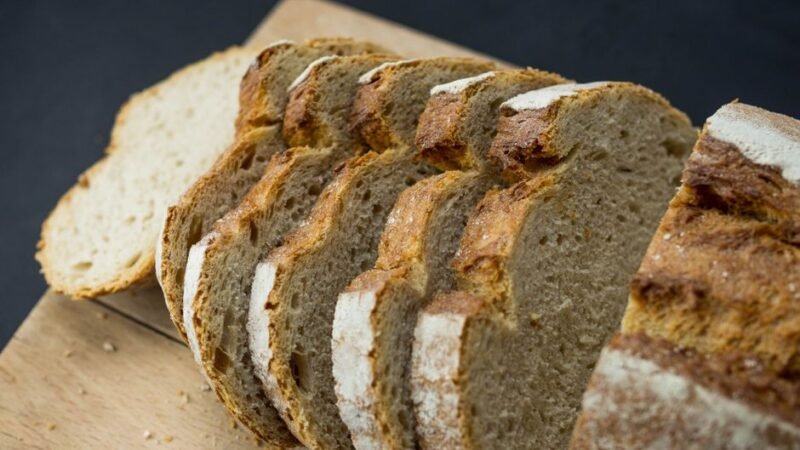
The loaf came out golden, sounded right, smelled better. You cut it after twenty minutes
because waiting seemed absurd — and the first slice was dense and slightly sticky.
That was the knife, not the oven
Inside a hot loaf, starch is still setting and steam is still redistributing.
Cutting into it lets that steam escape from the cut surface, and the crumb around it
collapses into something dense and tacky.
Bread genuinely continues to bake as it cools. Let it cool completely on a
rack — an hour for a small loaf, two or more for a large one, and ideally several
hours for rye.
A rack matters too: a loaf cooling on a board traps steam underneath and goes soggy there.
If the whole loaf is gummy, not just the first slice
Then it was underbaked, and appearance is a poor guide — the crust colours long before
the middle is done.
Use temperature. A lean loaf is done at roughly 93–96 °C
in the centre; enriched doughs with butter and egg at about 88–91 °C.
A digital thermometer settles this permanently and nothing else does.
If it is gummy and you did wait
Two remaining candidates.
Too much water in the dough. High-hydration loaves give an open moist
crumb by design, but past a point they cannot set. If yours are consistently gummy and you
have been adding water to make the dough easier to handle, reduce it.
Oven too hot. A hot oven sets the crust before heat reaches the centre.
The loaf browns, looks finished, stays raw. Lower the temperature and bake longer.
Rye is a special case
Rye contains enzymes that break down starch, so rye bread is dense and slightly sticky by
nature. It needs acidity — sourdough — to control this, and a long cool, often overnight,
before slicing. A rye loaf cut warm will always seem gummy no matter how well it was baked.
Where the gumminess sits
| What you see | Cause |
|---|---|
| Sticky near the cut, first slice only | Cut too warm |
| Dense wet layer at the bottom | Underbaked, or cooled on a board |
| Gummy throughout | Underbaked, or too much water |
| Dark crust, raw middle | Oven too hot |
More on this:
Why bread crust is soft ·
Why dough does not rise ·
Can you freeze bread ·
Why yeast dough smells like alcohol